 Add to Chrome
 Add to Firefox
 Add to Edge
Robo-Cortex: A Self-Evolving Embodied Agent via Dual-Grain Cognitive Memory and Autonomous Knowledge Induction
May 18, 2026
The ability to navigate and interact with complex environments is central to real-world embodied agents, yet navigation in unseen environments remains challenging due to "experiential amnesia," where existing trajectory-driven or reactive policies fail to synthesize generalizable strategies from past interactions. We propose Robo-Cortex, a self-evolving framework that enables robots to autonomously induce navigation heuristics and refine cognitive strategies through a continuous reflection-adaptation loop. By abstracting success patterns and failure pitfalls into natural-language heuristics, Robo-Cortex enables a transition from passive execution to active strategy evolution. Our core innovation is an Autonomous Knowledge Induction (AKI) mechanism that distills multimodal trajectories into a structured Navigation Heuristic Library for knowledge generalization. The architecture further incorporates a Dual-Grain Cognitive Memory system, comprising a Short-term Reflective Memory (SRM) for real-time local progress analysis, and a Long-term Principle Memory (LPM) that abstracts past trajectories into reusable guiding and cautionary principles. To ensure robust decision-making, we introduce a multimodal Imagine-then-Verify loop, where a world model simulates potential outcomes and a VLM-based evaluator validates action plans. Extensive evaluations on IGNav, AR, and AEQA show that Robo-Cortex consistently outperforms strong baselines in both task success and exploration efficiency, with gains of up to +4.16% SPL over the strongest prior method and up to +15.30% SPL under heuristic transfer to unseen environments. Preliminary real-world robotic experiments further support the effectiveness of Robo-Cortex in physical settings.

Pelican-Unified 1.0: A Unified Embodied Intelligence Model for Understanding, Reasoning, Imagination and Action
May 14, 2026We present Pelican-Unified 1.0, the first embodied foundation model trained according to the principle of unification. Pelican-Unified 1.0 uses a single VLM as a unified understanding module, mapping scenes, instructions, visual contexts, and action histories into a shared semantic space. The same VLM also serves as a unified reasoning module, autoregressively producing task-, action-, and future-oriented chains of thought in a single forward pass and projecting the final hidden state into a dense latent variable. A Unified Future Generator (UFG) then conditions on this latent variable and jointly generates future videos and future actions through two modality-specific output heads within the same denoising process. The language, video, and action losses are all backpropagated into the shared representation, enabling the model to jointly optimize understanding, reasoning, imagination, and action during training, rather than training three isolated expert systems. Experiments demonstrate that unification does not imply compromise. With a single checkpoint, Pelican-Unified 1.0 achieves strong performance across all three capabilities: 64.7 on eight VLM benchmarks, the best among comparable-scale models; 66.03 on WorldArena, ranking first; and 93.5 on RoboTwin, the second-best average among compared action methods. These results show that the unified paradigm succeeds in preserving specialist strength while bringing understanding, reasoning, imagination, and action into one model.
A2Eval: Agentic and Automated Evaluation for Embodied Brain
Feb 02, 2026Current embodied VLM evaluation relies on static, expert-defined, manually annotated benchmarks that exhibit severe redundancy and coverage imbalance. This labor intensive paradigm drains computational and annotation resources, inflates costs, and distorts model rankings, ultimately stifling iterative development. To address this, we propose Agentic Automatic Evaluation (A2Eval), the first agentic framework that automates benchmark curation and evaluation through two collaborative agents. The Data Agent autonomously induces capability dimensions and assembles a balanced, compact evaluation suite, while the Eval Agent synthesizes and validates executable evaluation pipelines, enabling fully autonomous, high-fidelity assessment. Evaluated across 10 benchmarks and 13 models, A2Eval compresses evaluation suites by 85%, reduces overall computational costs by 77%, and delivers a 4.6x speedup while preserving evaluation quality. Crucially, A2Eval corrects systematic ranking biases, improves human alignment to Spearman's rho=0.85, and maintains high ranking fidelity (Kendall's tau=0.81), establishing a new standard for high-fidelity, low-cost embodied assessment. Our code and data will be public soon.
Taiyi: A Bilingual Fine-Tuned Large Language Model for Diverse Biomedical Tasks
Nov 20, 2023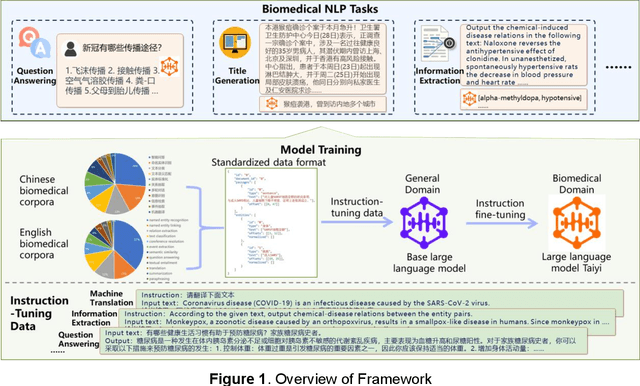
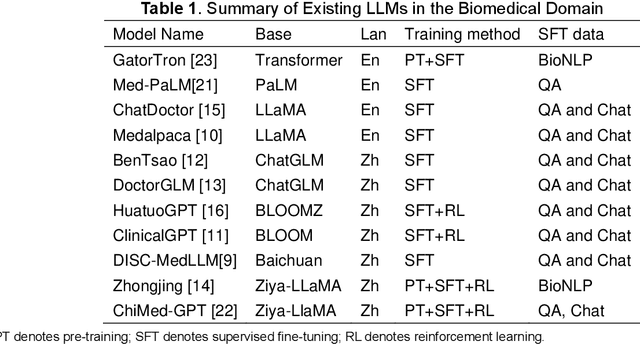
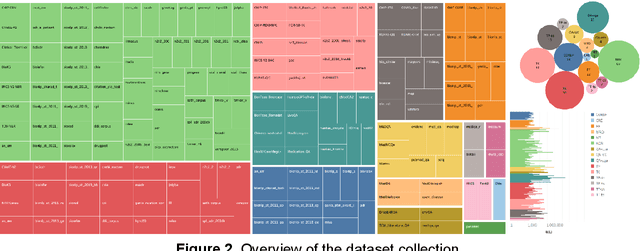
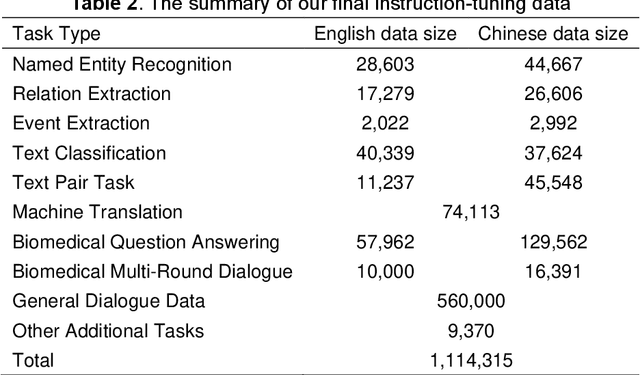
Recent advancements in large language models (LLMs) have shown promising results across a variety of natural language processing (NLP) tasks. The application of LLMs to specific domains, such as biomedicine, has achieved increased attention. However, most biomedical LLMs focus on enhancing performance in monolingual biomedical question answering and conversation tasks. To further investigate the effectiveness of the LLMs on diverse biomedical NLP tasks in different languages, we present Taiyi, a bilingual (English and Chinese) fine-tuned LLM for diverse biomedical tasks. In this work, we first curated a comprehensive collection of 140 existing biomedical text mining datasets across over 10 task types. Subsequently, a two-stage strategy is proposed for supervised fine-tuning to optimize the model performance across varied tasks. Experimental results on 13 test sets covering named entity recognition, relation extraction, text classification, question answering tasks demonstrate Taiyi achieves superior performance compared to general LLMs. The case study involving additional biomedical NLP tasks further shows Taiyi's considerable potential for bilingual biomedical multi-tasking. The source code, datasets, and model for Taiyi are freely available at https://github.com/DUTIR-BioNLP/Taiyi-LLM.